Volume Formula Calculator
Pick a shape, type its dimensions and get the volume, the formula and the answer in litres and gallons.
Recent
Your last 10 settings, saved only in this browser. Nothing is uploaded.
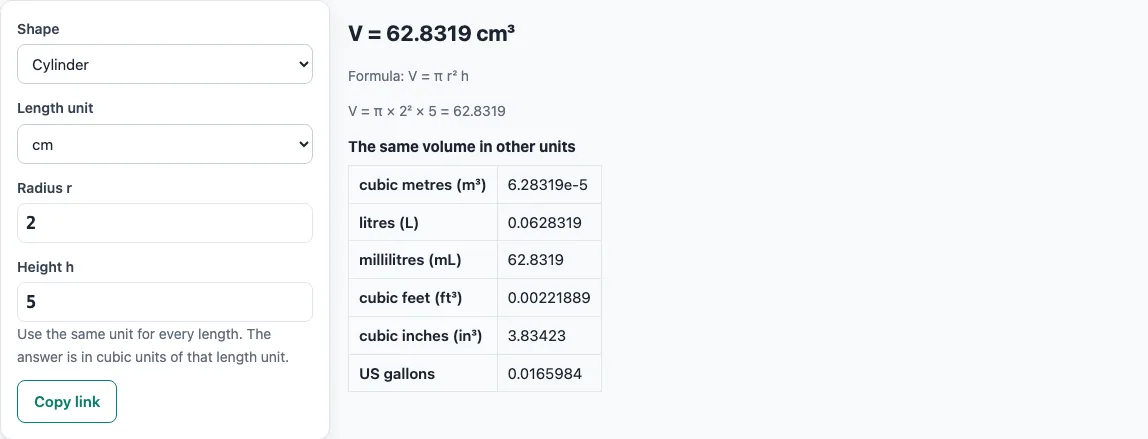
How to use the Volume Formula Calculator
- Open the Shape menu and choose your shape. The default is a cylinder.
- Open the Length unit menu and pick mm, cm, m, km, in, ft or yd.
- Type a value into each box for your shape. The labels tell you what each one means, such as Radius r, Height h or Bottom radius r₁.
- Check that every dimension is a number greater than zero. For a torus, the distance R from the centre to the middle of the tube must be larger than the tube radius r.
- Read the headline volume, then compare the formula with your numbers filled in.
- If you need another unit, look at the table called “The same volume in other units”. It covers cubic metres, litres, millilitres, cubic feet, cubic inches and US gallons.
Use the same unit for every length. Mixing units, such as a height in metres and a radius in centimetres, gives a wrong answer. The results update as you type, so you can change one number and see the volume change straight away. To compare shapes, switch the Shape menu and keep the same numbers. A sphere and a cube with a radius and side of 3, for example, give very different volumes. If a red message appears, fix the value it names: it is empty, not a number, or not greater than zero. Click Copy link to save your settings so you can return to the same calculation.
What is the volume formula?
Volume is the amount of three-dimensional space a shape takes up. Each shape has its own volume formula, but all of them measure how much space fills the inside of the shape.
For a cube with side length a, the formula is V = a³. For a rectangular box with length l, width w and height h, it is V = l × w × h. A cube with a = 4 has a volume of 64, and a box of 2 × 3 × 4 has a volume of 24.
What is the formula for the volume of a cylinder?
The volume of a cylinder is V = π r² h, where r is the radius of the circular base and h is the height. You multiply the area of the base, πr², by the height. For example, a cylinder with r = 2 and h = 5 has V = π × 2² × 5 = 20π, which is about 62.83 cubic units. This is the default calculation when you open the tool.
What is the formula for the volume of a sphere?
The volume of a sphere is V = (4/3) π r³, where r is the radius from the centre to the surface. This is the volume of a sphere formula for any ball-shaped object. For r = 3, V = (4/3) π × 27 = 36π, which is about 113.10 cubic units.
A hemisphere, which is half a sphere, has V = (2/3) π r³, so a sphere has twice the volume of a hemisphere with the same radius. A sphere also has two thirds the volume of the cylinder that just encloses it, a result first described by Archimedes.
What is the formula for the volume of a cone?
The volume of a cone is V = (1/3) π r² h, where r is the radius of the base and h is the perpendicular height from the base to the tip. A cone has one third the volume of a cylinder with the same base and height. For r = 3 and h = 4, V = (1/3) π × 9 × 4 = 12π, which is about 37.70 cubic units.
A cone frustum is a cone with the top cut off. Its volume is V = (1/3) π h (r₁² + r₁ r₂ + r₂²), where r₁ is the bottom radius and r₂ is the top radius. If r₁ = r₂, the frustum is a cylinder.
How do you find the volume of a rectangular prism?
A rectangular prism, also called a rectangular box or cuboid, has volume V = l × w × h, where l, w and h are its length, width and height. Multiply the three edges together. For a box with edges 2, 3 and 4, V = 24 cubic units.
A cube is a special case where all three edges are equal, so V = a³. A pyramid with a rectangular base has one third the volume of a prism with the same base and height, so its volume is V = (1/3) l w h.
What units is volume measured in?
Volume is measured in cubic units. If your lengths are in centimetres, the volume is in cubic centimetres (cm³). The unit is cubed because volume multiplies three lengths together.
Millilitres and litres are common volume units. One millilitre equals 1 cm³, and one litre equals 1,000 cm³. A cube with 10 cm sides has a volume of 1,000 cm³, which is 1 litre, or 0.001 m³. A cube 1 ft on each side holds about 28.32 litres.
Frequently asked questions
Is the Volume Formula Calculator free?
Yes. The tool is free to use. Everything is calculated in your browser, so nothing you type is uploaded.
Can the tool find a missing dimension if I know the volume?
No. The tool finds the volume from the dimensions you enter. It does not solve backwards for a missing dimension.
Does the tool calculate surface area?
No. The tool gives the volume only.
Why does my torus show an error?
For a torus, the distance R from the centre to the middle of the tube must be larger than the tube radius r. If R is not larger than r, the shape cannot form a ring.
Why must every dimension be greater than zero?
A shape with a length of zero or less does not take up space, so its volume cannot be calculated. Each box needs a positive number.
Should I use the same unit for every length?
Yes. Enter all dimensions in the same unit, then pick that unit in the Length unit menu. Mixing units produces a wrong volume.
Can I see the answer in another unit?
Yes. The table called “The same volume in other units” shows the result in cubic metres, litres, millilitres, cubic feet, cubic inches and US gallons.
Related tools
- Physics worksheets: use these for more practice with measurement and formula problems in physics.
- Chemistry worksheets: use these when you need more practice with measurement and volume in chemistry.
- States of matter worksheet: use this to practise how solids, liquids and gases take up space.
- Chemistry and physics worksheet tools: use this page to find the other physics and chemistry tools on the site.