Punnett Square Calculator
Type two parent genotypes (Aa, AaBb, even AaBbCc) to fill in the Punnett square and read off the genotype and phenotype ratios.
Recent
Your last 10 settings, saved only in this browser. Nothing is uploaded.
How to use the Punnett Square Calculator
- In the Parent 1 genotype box, type the first parent’s genotype. Use one letter pair per gene, such as
AaorAaBb. A capital letter marks the dominant allele. - In the Parent 2 genotype box, type the second parent’s genotype. Both parents need the same genes.
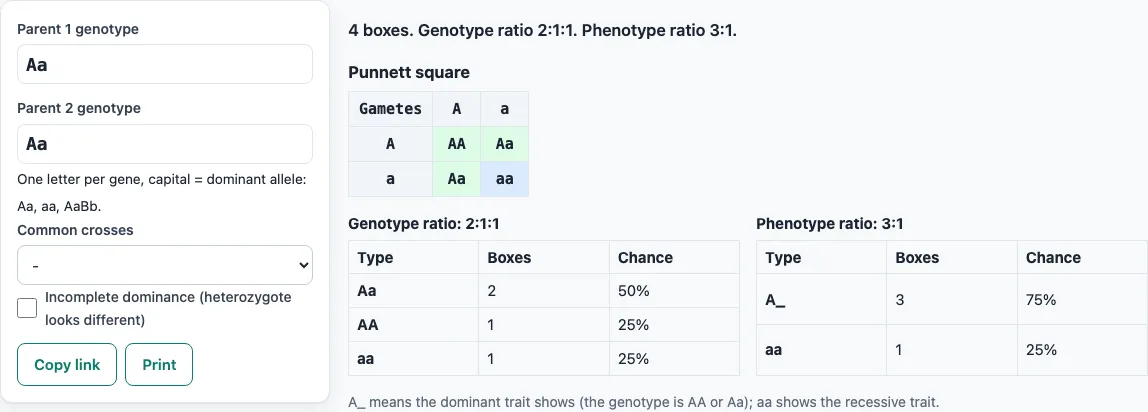
- Check the line near the top that shows the number of boxes and the genotype and phenotype ratios.
- Read the square. Parent 1’s gametes run down the side and parent 2’s run across the top. Boxes with the same phenotype share a colour.
- Read the Genotype ratio and Phenotype ratio tables. Each row gives the count of boxes and the percentage chance.
- If you want a ready-made cross, open the Common crosses menu and pick one, such as Aa x Aa or AaBbCc x AaBbCc.
- If an error message appears, follow its instruction and the results will update. The most common cause is a gene written with two different letters, such as Ab, or two genes sharing one letter.
- To look at a different phenotype split, tick Incomplete dominance (heterozygote looks different). Each genotype (AA, Aa, aa) then counts as its own phenotype.
Use Copy link to share the cross you have set up, and Print to open your browser’s print dialog.
How do you do a Punnett square
A Punnett square shows every possible combination of alleles that two parents can pass on. Each parent makes gametes (sex cells), and each gamete carries one allele of each gene. Aa makes an A gamete and an a gamete, while AA makes only A gametes and aa makes only a gametes.
Write one parent’s gametes down the side and the other parent’s across the top. Fill each box by combining the allele from its row with the allele from its column. Each box has the same chance of occurring, so counting boxes gives the ratio. For Aa x Aa, the four boxes are AA, Aa, Aa and aa, giving a genotype ratio of 1 AA : 2 Aa : 1 aa, or 25%, 50% and 25%.
What is a dihybrid cross
A dihybrid cross follows two genes at the same time, such as AaBb x AaBb. Each parent makes four gamete types: AB, Ab, aB and ab. This works because the genes assort independently, meaning they sort into gametes separately, which holds for genes on different chromosomes.
Four gamete types from each parent give a grid of 4 rows by 4 columns, so 16 boxes in total. The same logic extends to three genes: AaBbCc x AaBbCc gives 8 gamete types per parent and a 64-box square.
What is the phenotype ratio of a dihybrid cross
For AaBb x AaBb, the phenotype ratio is 9:3:3:1. To find it, group the 16 boxes by visible trait. The 9 boxes with at least one dominant allele of each gene are A_B_, the 3 boxes with dominant A and recessive bb are A_bb, the 3 boxes with aa and at least one dominant B are aaB_, and the single box aabb shows both recessive traits.
The same 9:3:3:1 pattern appears in the University of Arizona Biology Project dihybrid cross problem set (SsYy x SsYy: 9 spherical-yellow, 3 spherical-green, 3 dented-yellow, 1 dented-green). The pattern needs both parents to be heterozygous for both genes. If either parent is homozygous for a gene, the ratio changes.
What is a test cross
A test cross crosses an individual that shows the dominant trait with a homozygous recessive (aa) to find out whether it is AA or Aa. If all the offspring show the dominant trait, the unknown parent is most likely AA. If about half show the recessive trait, the unknown parent is Aa.
For Aa x aa, the ratio is 1:1 (50% Aa and 50% aa). For AA x aa, every offspring is Aa. A dihybrid test cross, AaBb x aabb, gives 1:1:1:1. The test works because a recessive trait shows only when both alleles are recessive, so the aa parent reveals which dominant alleles the other parent carries.
What is the difference between genotype and phenotype
The genotype is the combination of alleles an organism carries, such as Aa. The phenotype is the visible trait that results from that combination. A dominant allele shows when it is present, but a recessive trait shows only with two recessive alleles (aa).
This means AA and Aa have different genotypes but the same phenotype, which the tool writes as A_. The genotype ratio and the phenotype ratio of the same cross are therefore often different. With incomplete dominance ticked, the heterozygote is shown as its own phenotype, so AA, Aa and aa each appear separately.
Frequently asked questions
Can the Punnett Square Calculator do three genes?
Yes. It handles up to three genes, such as AaBbCc x AaBbCc, which gives a 64-box square and the ratio 27:9:9:9:3:3:3:1. Each gene needs its own letter, and both parents need the same genes.
Is the Punnett Square Calculator free?
Yes. Everything on this page is free to use. Nothing you type is uploaded, because all the calculation happens in your browser.
What is a monohybrid cross calculator used for?
Use it for a single gene, such as Aa x Aa. Choose Monohybrid Aa x Aa from the Common crosses menu, or type your own parents. Aa x Aa gives 4 boxes and a 3:1 phenotype ratio.
Why does my Punnett square show an error message?
Most errors come from the input rules. Each gene needs two letters of the same letter in any case (Aa, AA or aa), each gene needs its own letter, and both parents need the same genes. The error message explains what to fix.
Does the tool work for linked genes or blood groups?
No. The tool assumes genes assort independently and complete dominance, unless you tick incomplete dominance. It does not model linked genes, sex-linked traits or multiple alleles, such as ABO blood groups.
What does incomplete dominance change?
When the box is ticked, each genotype counts as its own phenotype. For Aa x Aa, you then see three phenotypes (AA, Aa and aa) instead of two (A_ and aa).
Can I share or print my result?
Yes. Copy link saves the cross you have set up in a link you can share. Print opens your browser’s print dialog.
Related tools
- Biology worksheets: Choose genetics, cells or the human body and print a worksheet with an answer key.
- DNA vs RNA: Compare the two nucleic acids and convert a DNA sequence to mRNA and protein.
- Cell labeling worksheet: Use this to practise naming cell parts, which often comes before genetics in a biology course.
- Animal classification worksheet: Use this to practise sorting animals into groups, a common companion topic to inheritance.
- Food chain worksheet: Print food chains and webs to label, with an answer key.
- Life cycle worksheets: Print the life cycles of a frog and a chicken to label and order.