Potential Energy Calculator
Choose gravitational or spring energy, type what you know and read the potential energy in joules, with the formula worked out step by step.
Recent
Your last 10 settings, saved only in this browser. Nothing is uploaded.
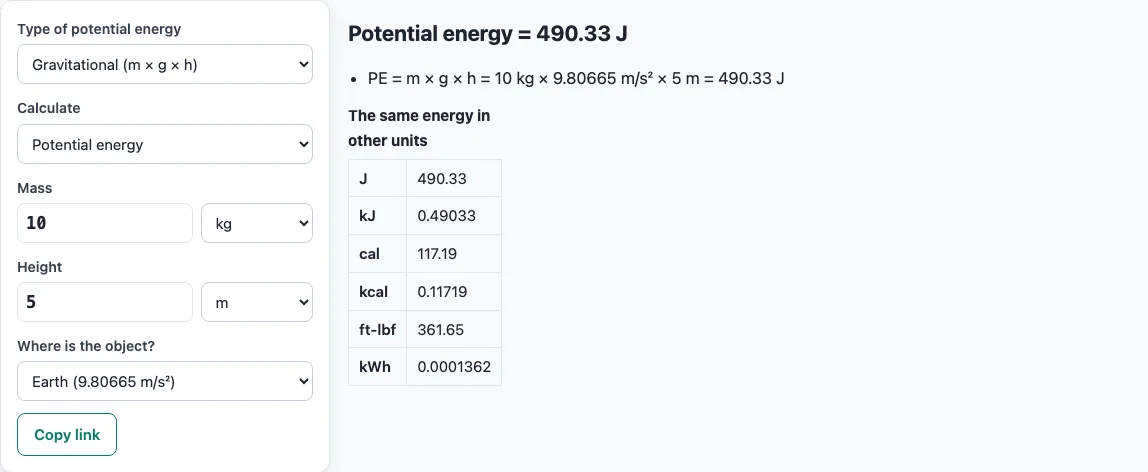
How to use the potential energy calculator
- In the menu Type of potential energy, choose Gravitational (m × g × h) or Elastic spring (½ × k × x²).
- Open the Calculate menu and choose the unknown. For gravitational energy you can pick Potential energy, Mass, Height or Gravity (g, m/s²). For spring energy you can pick Potential energy, Spring constant k (N/m) or Stretch or compression.
- For gravitational energy, type the mass and height into their boxes. Choose the mass unit (kg, g, lb or oz) and the height unit (m, cm, mm, ft, in or yd) from the menus beside them.
- For spring energy, type the spring constant in N/m and the stretch or compression. Choose its unit from the length menu.
- In Where is the object?, select Earth, Moon, Mars, Venus or Jupiter. To use another gravity, select Another value of g and type it into the Gravity (g, m/s²) box.
- If you know the energy, choose its unit (J, kJ, cal, kcal, ft-lbf or kWh) from the energy menu.
- Read the headline answer, such as “Potential energy = 490.33 J”, and the line below it that shows the formula with your numbers filled in.
- If energy is the answer, check the table The same energy in other units, which lists J, kJ, cal, kcal, ft-lbf and kWh.
Results update as you type, so you can change one number and watch the answer change. To keep your settings, press Copy link, which saves them inside the link you can bookmark or send.
What is potential energy
Potential energy is stored energy that an object has because of its position or its condition. It is energy that can be released later, like a book on a high shelf or a bowstring that has been drawn back.
Potential energy is relative, so only differences in position matter. You choose the zero level, called the reference level, and the energy is measured from there. Other forms exist, including chemical, electric and nuclear potential energy, but this tool covers only gravitational and spring energy.
What is the formula for potential energy
The formula depends on how the energy is stored. Use PE = m g h when an object is raised in a gravitational field, and use PE = ½ k x² when a spring is stretched or compressed.
Both formulas give energy in joules when you use kilograms, metres, newtons per metre and metres per second squared. Check that your units match before you multiply.
How do you calculate gravitational potential energy
Multiply mass, gravity and height: PE = m × g × h. Mass is in kilograms, gravity in m/s² and height in metres, and the result is in joules. On Earth, standard gravity is 9.80665 m/s².
Gravitational potential energy grows in direct proportion to height, so doubling the height doubles the energy. For example, a 10 kg object raised 5 m on the Moon, where g = 1.62 m/s², has 10 × 1.62 × 5 = 81 J. A negative height gives a negative result, which means the object is below your chosen reference level. The constant value of g is accurate near a planet’s surface but not for very large heights.
How do you calculate the potential energy of a spring
Elastic potential energy, also called spring potential energy, is PE = ½ k x². Here k is the spring constant in N/m and x is the stretch or compression in metres. The formula applies to an ideal spring that obeys Hooke’s law, where the force is F = k x.
Because x is squared, the energy grows faster than the stretch. Doubling the stretch gives four times the energy. For a spring with k = 200 N/m stretched 0.1 m, the energy is ½ × 200 × 0.1² = 1 J.
What units is potential energy measured in
The SI unit of energy is the joule (J). One joule equals one newton metre, or 1 kg m²/s². Larger amounts are often written in kilojoules (kJ), where 1 kJ = 1,000 J.
Energy is also given in calories, kilocalories, foot-pounds force (ft-lbf) and kilowatt-hours (kWh). Using 1 cal = 4.184 J, a 490.33 J result is about 117.19 cal. Choose the unit that fits your course or task.
What is the difference between potential and kinetic energy
Potential energy is energy of position or condition, while kinetic energy is energy of motion, given by ½ m v². When an object falls without friction, potential energy turns into kinetic energy, so m g h = ½ m v².
Solving that equation gives the speed after falling a height h: v = √(2 g h). An object dropped from 5 m on Earth reaches about √(2 × 9.80665 × 5) ≈ 9.90 m/s just before it lands.
Frequently asked questions
Does the tool use metric units?
Its default units are kilograms, metres and joules, which are SI units. The unit menus also accept g, lb, oz, cm, mm, ft, in, yd, kJ, cal, kcal, ft-lbf and kWh, so you can use whichever units your problem gives.
Is the potential energy calculator free?
Yes. The tool is free to use, and everything is calculated in your browser, so nothing you type is uploaded.
Why is my gravitational potential energy negative?
A negative height means the object sits below the reference level you chose, so its potential energy is negative. Check whether your zero level is where you intended.
Why can’t I solve for mass, gravity or k when the height or stretch is zero?
If the height or stretch is zero, the energy is zero whatever the mass, gravity or spring constant, so the formula cannot be turned around to find them. Enter a height or stretch above zero to find the unknown.
How do I find the height for a given amount of energy?
Choose Calculate: Height, then enter the mass, gravity and energy. For a 20 kg object with 1,000 J on Earth, the height is 5.0986 m.
Can I use the calculator on other planets?
Yes. Select the Moon, Mars, Venus or Jupiter under Where is the object?, or enter your own value under Another value of g. The tool uses a constant g, which is fine near a planet’s surface.
Why do I see “must be a number”?
That message appears when a box contains text or symbols that are not a number. Remove the extra characters and type only digits and a decimal point.
Related tools
- Physics worksheets: Use these when you want practice problems on energy and motion to work through by hand.
- Scientific method worksheet: Use this when you are planning an experiment, such as dropping objects or stretching springs, and need a structured record.
- Lab report template: Use this when you are writing up a lab that measures energy, so your results, calculations and conclusions are laid out clearly.
- Chemistry and physics worksheet tools: Use this page to find the other physics and chemistry tools on the site.