Newton's First Law Calculator
Add the forces on an object and see at once whether they balance, what the net force is and how fast the object accelerates.
Recent
Your last 10 settings, saved only in this browser. Nothing is uploaded.
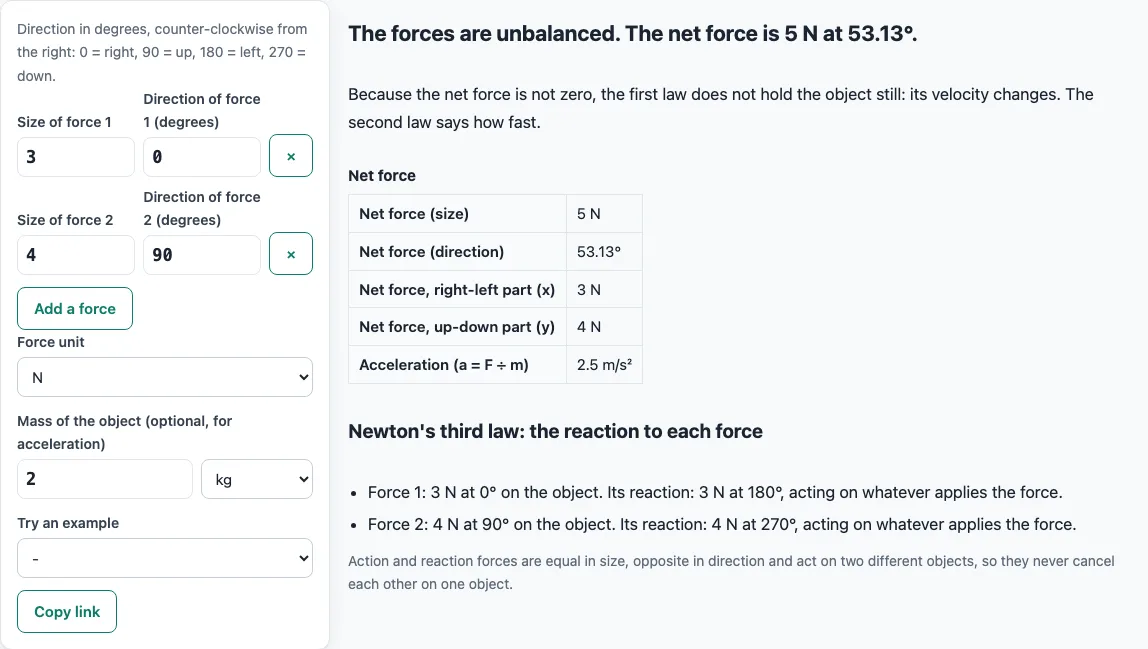
How to use the Newton’s laws calculator
- Open the Try an example menu to load a ready-made case, such as “Book resting on a table” or “Tug of war evenly matched”. Or skip this and enter your own forces.
- In the first row, type the force in the Size of force 1 box and pick its unit from the Force unit menu (N, kN or lbf).
- In Direction of force 1 (degrees), type the angle counter-clockwise from the right: 0 is right, 90 is up, 180 is left and 270 is down.
- Click Add a force to add another row, up to six forces in total. Click the × button on a row to remove that force.
- If you want acceleration, type the object’s mass in the Mass of the object (optional, for acceleration) box and choose kg, g or lb from the menu next to it.
- Read the headline. It says either “The forces are balanced. The net force is zero.” or gives the net force size and angle.
- Check the Net force table for the size, direction, x part, y part and, if you entered a mass, the acceleration.
- Scroll to Newton’s third law: the reaction to each force to see the equal and opposite reaction for every force you entered.
The default setup is 3 N at 0° and 4 N at 90° on a 2 kg object. Use Copy link to save your forces and settings in a link you can reopen later.
What is Newton’s first law?
Newton’s first law, also called the law of inertia, states that an object keeps its state of motion unless a net force changes it. A resting object stays at rest, and a moving object keeps going in a straight line at constant speed. Forces only change motion when they do not cancel out.
What are balanced forces?
Balanced forces are forces whose vector sum is zero, so the net force is zero. They do not change an object’s motion, which means a balanced object can still be moving at a constant velocity. A book on a table is the standard case: its weight of 20 N pulls down at 270°, and the table’s normal force of 20 N pushes up at 90°. The forces are balanced, so the book stays still. Forces are unbalanced when the net force is not zero.
How do you calculate net force?
Net force is found by adding forces as vectors, not as plain numbers. Split each force into two parts: the x part (size × cos(angle)) and the y part (size × sin(angle)). Add all the x parts together and all the y parts together. The net force size is the square root of (total x)² + (total y)², and its direction is given by atan2 of total y and total x.
For example, 3 N to the right plus 4 N up gives x = 3 and y = 4. The net force is 5 N at 53.13°, which is a 3-4-5 triangle. Two 10 N forces 60° apart give a net force of 17.32 N. A net force smaller than a tiny tolerance counts as zero, so the forces are reported as balanced.
What is Newton’s second law?
Newton’s second law states that net force equals mass times acceleration, written F = m a. Acceleration is therefore the net force divided by the mass. A newton is the force that gives a 1 kg object an acceleration of 1 m/s², so 1 N = 1 kg m/s².
Take 10 N to the right and 6 N to the left on a 2 kg object. The net force is 4 N to the right, and the acceleration is 4 ÷ 2 = 2 m/s². A 20 N net force on a 5 kg object gives 4 m/s². The three laws of motion were published by Isaac Newton in 1687 in the Principia.
What is Newton’s third law?
Newton’s third law (also written Newton’s 3rd law, or Newton’s 3ed law as it is often typed) states that when one object pushes on another, the second object pushes back on the first with a force of the same size in the opposite direction. The two forces are called an action and a reaction. A reaction force has the same size as the action and points the opposite way, which means its angle is the original angle plus 180°. The tool lists this reaction for each force you enter.
What is an example of Newton’s third law?
A rocket pushes gas out of its engine, and the gas pushes the rocket forward. When you walk, your foot pushes back on the ground, and the ground pushes you forward. A book resting on a table pulls the Earth up with the same force that the Earth pulls the book down.
Why do action and reaction forces not cancel?
Action and reaction forces act on two different objects, so they never add together on one object. Cancellation only happens when two forces act on the same object. In the rocket example, the force on the gas and the force on the rocket each act on a different body, so each one changes only its own object’s motion.
Frequently asked questions
Is this Newton’s laws calculator free to use?
Yes. The tool is free to use, and all calculations run in your browser. Nothing you type is uploaded.
Does the tool calculate friction or weight for me?
No. You enter every force yourself, including friction or weight if your problem includes them. The tool then adds the forces you give it.
Can I enter forces in pounds-force?
Yes. Choose lbf from the Force unit menu. One lbf equals 4.4482 N, so 10 lbf equals 44.48 N.
How many forces can I add?
You can enter up to six forces. Click Add a force to add a row, and click the × button to remove one.
Does the tool work in three dimensions?
No. Forces are placed in a flat plane, so each force uses one angle measured from the right.
What does “The forces are balanced” mean?
It means the net force is zero. By Newton’s first law, an object with balanced forces keeps its current motion, whether that is rest or constant velocity.
Why does the acceleration row sometimes not appear?
The acceleration is shown only when you enter a mass. Without a mass, the tool can report the net force but cannot divide it by mass to find acceleration.
Related tools
- Physics worksheets: Use these when you want practice problems on forces and motion to work through without the calculator.
- Scientific method worksheet: Use this to plan a simple experiment, such as testing how a force changes an object’s motion.
- Lab report template: Use this to write up your results once you have recorded forces, masses and accelerations from an experiment.
- Chemistry and physics worksheet tools: Use this page to find the other physics and chemistry tools on the site.