Karyotype Reader
Type a karyotype the way a lab writes it, like 46,XX or 47,XY,+21, and see what it says about the chromosomes.
Recent
Your last 10 settings, saved only in this browser. Nothing is uploaded.
The karyotype reader is a free tool that turns karyotype notation, such as 47,XX,+21, into a plain-language summary and a chart of chromosome copies. A karyotype is the full set of chromosomes in a cell, shown or written in an organised way. Type a notation into the box and the reader names well-known karyotypes, counts the chromosomes, lists gains, losses and rearrangements, and flags anything it cannot read.
The tool runs in your browser. Nothing you type is uploaded. It is built for learning how karyotypes are written and read, not for medical diagnosis. Try the examples to see how a typical male or female karyotype, a trisomy, a missing sex chromosome, a translocation and a mosaic each look in notation and in the chart.
How to read a karyotype
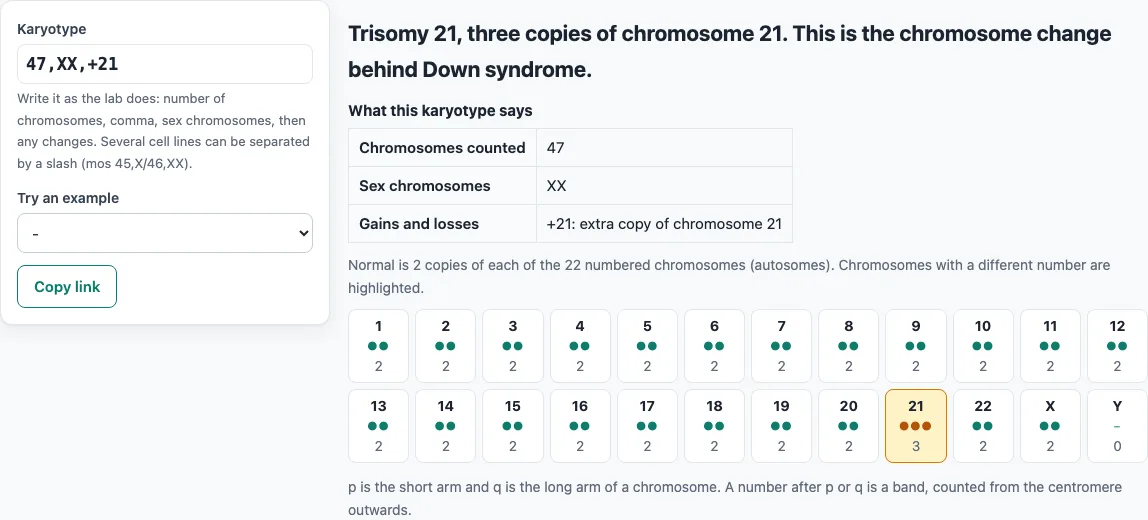
- Open the Try an example menu and choose 47,XX,+21 (trisomy 21) to see a finished result, or click into the Karyotype text box and start typing.
- Write the total number of chromosomes, then a comma, then the sex chromosomes. For a typical female cell, type 46,XX.
- Add any changes after another comma. Use + for an extra copy, so +21 adds one more chromosome 21. Use - for a missing copy, so -7 removes one chromosome 7.
- Add rearrangements in the same style, with the chromosome in the first brackets and breakpoints in the second, such as t(9;22)(q34;q11.2).
- Read the output from top to bottom. Start with the named result sentence, then check the table called What this karyotype says, then look at the chart. Tiles with a number of copies other than the normal 2 are highlighted.
- Check for warnings. If the total does not match the changes, fix it. For example, 46,XX,+21 adds up to 47, so change the total to 47.
Results update as you type, so you can change one part at a time and watch the table and chart change. Cell counts in square brackets, such as [10], are ignored, so you can leave them in. To share your notation, press Copy link. The notation is saved inside the link.
What is a karyotype?
A karyotype is the full set of chromosomes in a cell, arranged in an organised way. A typical human cell has 46 chromosomes: 22 pairs of autosomes and 2 sex chromosomes, usually XX in females and XY in males.
Each chromosome has a short arm, labelled p (from the French petit), and a long arm, labelled q. Bands on each arm are numbered outward from the centromere, the constriction that sits between the two arms. This is how a location such as q34 is pinpointed. The standard notation is the ISCN, the International System for Human Cytogenomic Nomenclature.
What does 47,XX,+21 mean?
47,XX,+21 is a karyotype with 47 chromosomes, two X sex chromosomes and one extra chromosome 21. Read it left to right: 47 is the total, XX is the sex chromosome pattern, and +21 is the change. A typical cell has two copies of each autosome, so a third copy of chromosome 21 is called trisomy 21.
The reader names this karyotype as trisomy 21 and says it is the chromosome change behind Down syndrome. The same pattern with a Y, 47,XY,+21, describes a male cell with trisomy 21.
What does 46,XY mean?
46,XY is the karyotype of a typical male cell. The 46 is the total number of chromosomes, made up of 22 pairs of autosomes and one pair of sex chromosomes. XY means one X and one Y, which is the usual male pattern.
Because nothing follows the sex chromosomes, there are no changes. Every autosome has its normal two copies. The reader labels 46,XY a typical male karyotype, and its chart shows no highlighted tiles. The female equivalent is 46,XX.
What is the difference between autosomes and sex chromosomes?
Autosomes are chromosomes 1 to 22. They come in 22 pairs, and both males and females have the same numbers of each. Sex chromosomes are X and Y, and they are the pair that usually differs between the sexes: XX in females and XY in males.
In karyotype notation, the sex chromosomes come straight after the total, as in 46,XX or 46,XY. Changes to autosomes are written as numbers with a sign, such as +21 or -7. Changes to sex chromosomes use the same signs with the letter, such as +X or -Y.
How is a karyotype made?
A karyotype is made in a laboratory. Cells are grown, then stopped while they are dividing, at metaphase, when the chromosomes are most visible. The chromosomes are stained to show a banding pattern and photographed.
The chromosomes are then arranged in pairs by size, banding pattern and centromere position. The karyotype reader does not perform any of these steps. It works only from typed notation, not from a picture of chromosomes.
What does t(9;22) mean?
t(9;22)(q34;q11.2) describes a translocation between chromosomes 9 and 22. In a translocation, pieces of two chromosomes swap places. The first brackets name the chromosomes involved, and the second brackets give the breakpoints, the positions on the long arms where the breaks happen.
A translocation moves material rather than adding or removing a whole chromosome, so the reader does not change the total count. It flags t(9;22)(q34;q11.2) as the Philadelphia chromosome, which is found in most people with chronic myeloid leukemia. The reader does not check whether a rearrangement is physically possible.
Frequently asked questions
Is the karyotype reader free to use?
Yes, the tool is free to use. Everything is calculated in your browser, so nothing you type is uploaded.
Can I upload a photo of chromosomes?
No. The reader works only with typed karyotype notation and does not analyse pictures of chromosomes.
Can this tool be used to diagnose a condition?
No. It is for learning how karyotypes are written and read, not for medical diagnosis. If you have a real karyotype result, ask a doctor or genetic counsellor to explain it.
Why does the reader show a warning?
A warning appears when the stated total does not match the changes, as with 46,XX,+21, which adds up to 47. Warnings also appear for an empty box, a missing chromosome number or sex chromosomes, a number outside 23 to 92, or a minus sign that would leave fewer than zero copies.
What do p and q mean in a karyotype?
p is the short arm of a chromosome, and q is the long arm. A location such as q34 means band 34 on the long arm, with bands numbered outward from the centromere.
What does mos mean in a karyotype?
mos stands for mosaic, which means a person has two or more cell lines with different karyotypes. Separate the cell lines with a slash, as in mos 45,X/46,XX, and the reader checks each line separately.
Where can I find karyotype examples to try?
The Try an example menu includes 46,XX (typical female), 46,XY (typical male), 47,XX,+21 (trisomy 21), 45,X (monosomy X), 47,XXY, 46,XX,t(9;22)(q34;q11.2) and mos 45,X/46,XX (mosaic). Each one shows how a different type of change appears in the output.
Related tools
- Punnett square calculator: use it to predict how traits are passed from parents to offspring.
- DNA vs RNA: use it to compare the structure and role of the two nucleic acids.
- Biology worksheets: use them for practice questions across topics in biology.
- Cell labeling worksheet: use it to practise naming the parts of a cell.