Homogeneous Mixture vs Heterogeneous Mixture
Look up a substance, answer two questions about your own sample, or practise with a quiz to tell a homogeneous mixture from a heterogeneous one.
Recent
Your last 10 settings, saved only in this browser. Nothing is uploaded.
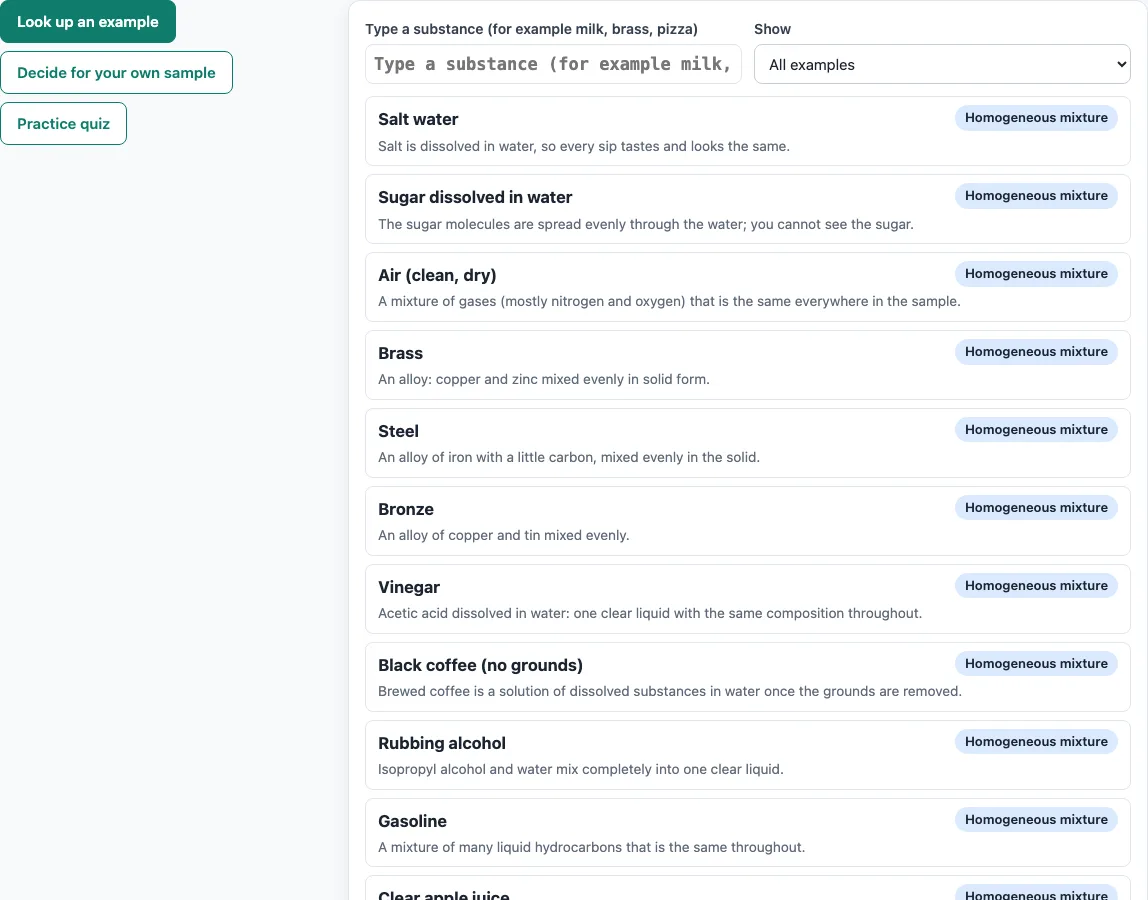
How to use the homogeneous vs heterogeneous mixture tool
The tool has three tabs. Choose the one that fits your question.
- Open the Look up an example tab. Type a substance in the search box, such as milk, brass or pizza.
- Use the Show menu to filter results: All examples, Homogeneous mixtures, Heterogeneous mixtures, Pure substances (elements and compounds), or Borderline cases.
- Read each result. It shows the substance, a coloured badge for its type and a one-sentence reason.
- For a sample that is not on the list, open the Decide for your own sample tab.
- Answer question 1: “Is it only one substance with a fixed formula (one element or one compound, like gold or water)?” If yes, the result is a pure substance.
- If no, answer question 2: “Can you see different parts in it, or separate them with your hands or a filter (pieces, layers, particles that settle)?” Yes gives a heterogeneous mixture. No gives a homogeneous mixture (a solution).
- To test yourself, open the Practice quiz tab. For each random substance, choose Homogeneous mixture, Heterogeneous mixture or Pure substance. Your running score updates, and Next substance brings up the next one.
Copy link saves the tab you are on and your search, so you can return to the same example later or send it to someone.
What is a homogeneous mixture?
A homogeneous mixture is a mixture with the same composition and properties throughout, so you cannot see its separate parts. It contains two or more substances that are physically combined, not chemically bonded.
Solutions are the most common type. A solution is a solute dissolved in a solvent, such as sugar dissolved in water. Other examples include alloys like brass (copper and zinc), steel, bronze, vinegar, black coffee without grounds, rubbing alcohol, gasoline and clear apple juice.
What is a heterogeneous mixture?
A heterogeneous mixture has parts with different composition that you can see or pick apart. The parts may be pieces, layers or particles that settle over time.
Common examples include sand and water, oil and water, salad, pizza, granite, concrete, soil, trail mix, cereal in milk, muddy water and chocolate chip cookies. Orange juice with pulp is also heterogeneous, because the pulp is visible.
What is the difference between homogeneous and heterogeneous mixtures?
The main difference is uniformity at ordinary scale. A homogeneous mixture looks and behaves the same in every part of the sample. A heterogeneous mixture has visible or separable parts that differ from each other.
Both types can be separated by physical methods, such as filtering, evaporating, distilling, using a magnet or sorting by hand. A pure substance is neither type. It has a fixed composition and is not a mixture. Compounds such as table salt need a chemical reaction to be broken down.
Is milk homogeneous or heterogeneous?
Milk is a borderline case. It looks uniform, but it contains tiny fat droplets spread through water. This makes it a colloid. Textbooks disagree on whether colloids should be called homogeneous or heterogeneous, so the tool lists milk as borderline. Fog is another colloid and falls into the same category.
Is air a homogeneous mixture?
Clean, dry air is a homogeneous mixture of gases, mostly nitrogen and oxygen. Its gases are evenly mixed, so you cannot see separate parts. Air with visible dust or smoke in it would contain separable particles, so it would not count as homogeneous.
Is salt water a homogeneous mixture?
Salt water is homogeneous only when the salt is fully dissolved. In that case the salt is the solute and the water is the solvent. If undissolved salt crystals sit at the bottom, the sample is heterogeneous.
How to tell a homogeneous mixture from a heterogeneous mixture
Look for different parts, layers or particles that settle. If you see any of these, the mixture is heterogeneous. A mixture that stays uniform, clear and does not settle is likely homogeneous.
Scale matters. Almost every sample looks heterogeneous if you zoom in far enough, so classification uses what you can see or separate at ordinary scale. You may also see the spelling “homogenous.” It is a common variant of homogeneous.
Frequently asked questions
Is this tool free to use?
Yes. The tool is free, and it runs in your browser. Nothing you type is uploaded.
What is a homogeneous mixture?
A homogeneous mixture has the same composition throughout, so its separate parts cannot be seen. Salt water, brass and clear apple juice are examples.
What is a heterogeneous mixture?
A heterogeneous mixture has parts with different composition that you can see or separate. Sand and water and salad are examples.
Is milk homogeneous or heterogeneous?
Milk is a borderline case. It looks uniform but is a colloid, and textbooks classify colloids differently.
Is salt water a homogeneous mixture?
Yes, as long as the salt is fully dissolved. Undissolved salt that settles makes it heterogeneous.
Is air a homogeneous mixture?
Clean, dry air is a homogeneous mixture of gases, mostly nitrogen and oxygen.
What is the difference between a mixture and a pure substance?
A mixture combines two or more substances that keep their own properties and can be separated by physical means such as filtering. A pure substance is a single element or compound with a fixed composition, so it cannot be separated that way.
Can the tool check any substance?
No. The look-up list covers about 40 examples. For any other substance, use the Decide for your own sample tab.
Related tools
- States of matter worksheet: Use it to practise solids, liquids and gases, which helps when you compare gas mixtures such as air.
- Chemistry worksheets: Use it for more practice across chemistry topics.
- Naming compounds practice: Use it when you need to name compounds such as table salt or baking soda.
- Periodic table printable: Use it to look up the elements that appear in the pure-substance examples, such as gold, iron and helium.