How Much Does a Gallon of Water Weigh?
Type an amount of water and a temperature to see its weight in pounds, kilograms and ounces. One US gallon of fresh water at 20 °C weighs 8.33 lb.
Recent
Your last 10 settings, saved only in this browser. Nothing is uploaded.
How much does a gallon of water weigh? About 8.33 pounds, or 3.78 kilograms, at 20 °C for a US gallon of fresh water. This tool gives the exact weight of any amount of water, in the unit you choose, and it uses the temperature you enter for fresh water or a fixed typical density for seawater. It runs in your browser and is free to use.
Use it when you need a precise figure instead of a rough rule of thumb, such as for shipping, tank loads, cooking, or a science class. The default setting is one US gallon of fresh water at 20 °C, so the common answer appears as soon as the page loads. You can switch to imperial gallons, litres, cups, or cubic metres, and read the result in pounds, kilograms, ounces, short tons and metric tonnes.
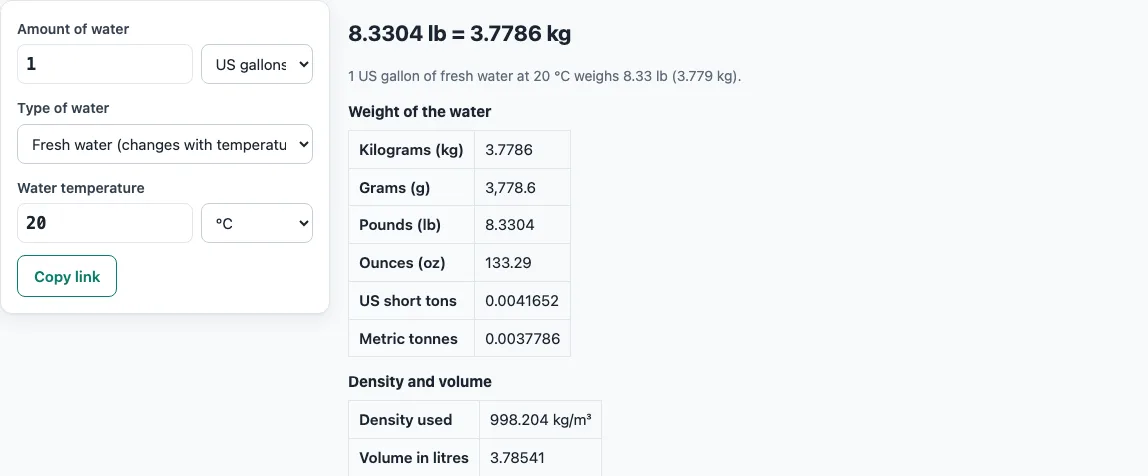
How to find the weight of a gallon of water
- Find the box labelled Amount of water. The default is 1, which is one US gallon.
- Open the unit menu next to it and choose US gallons, imperial (UK) gallons, or another unit such as litres.
- Open the Type of water menu and choose Fresh water (changes with temperature) or Seawater (typical, 1,025 kg/m³).
- If you chose fresh water, type the temperature in the Water temperature box. Use the °C / °F menu to pick the scale. Allowed values are 0 to 100 °C, or 32 to 212 °F.
- Read the headline at the top of the results, for example 8.3304 lb = 3.7786 kg.
- Scroll to the Weight of the water table to see kilograms, grams, pounds, ounces, US short tons and metric tonnes.
- Check the Density and volume table to see the density used and the volume in litres.
If you want a quick answer, leave the defaults and read the headline. If you need a particular amount, such as 5 gallons or a 55-gallon drum, replace the 1 in the amount box. The results update as you type, so there is no button to press. If you enter a temperature outside the allowed range, or text that is not a number, a red message tells you what to change.
The Copy link button saves your current settings in a link, so you can return to the same amount, unit and temperature later.
How is the weight of a gallon of water calculated?
The weight of water is its volume multiplied by its density. The tool first converts your amount to litres using exact definitions: 1 US gallon is 3.785411784 litres, 1 imperial gallon is 4.54609 litres, and 1 pound is 0.45359237 kg. It then finds the density of pure water at your temperature and multiplies the two numbers.
For fresh water, the density comes from the Kell (1975) formula, which covers 0 to 100 °C at normal air pressure. It matches standard table values, such as 998.2 kg/m³ at 20 °C and 997.05 kg/m³ at 25 °C.
How much does a gallon of water weigh?
A US gallon of fresh water weighs about 8.33 pounds at room temperature. At 20 °C the tool gives 8.3304 lb. Across its full range, the value changes only a little, from 8.3441 lb at 0 °C to 7.9979 lb at 100 °C. Between about 0 °C and 25 °C the answer stays between 8.32 and 8.35 pounds.
How much does a gallon of water weigh in kg?
A US gallon of water weighs about 3.78 kg at 20 °C, or exactly 3.7786 kg in the tool. At 4 °C, the temperature of maximum density, it is 3.7853 kg. At 100 °C it is 3.6278 kg. To convert pounds to kilograms, multiply by 0.45359237.
How much does an imperial gallon of water weigh?
An imperial gallon of water weighs about 10 pounds at 20 °C, or 10.004 lb in the tool. That is about 4.54 kg. An imperial gallon is 4.54609 litres, which holds about 20% more than a US gallon.
Does the weight of water change with temperature?
Yes, but only slightly. Water is densest at about 4 °C and gets a little lighter as it warms, because it expands. For the same US gallon, the weight drops from 8.3441 lb at 0 °C to 8.3304 lb at 20 °C and 8.2052 lb at 60 °C. Between 20 °C and 25 °C, the difference is only about 0.01 lb.
How much does a litre of water weigh?
A litre of water weighs about 1 kilogram. At 4 °C it weighs 0.99997 kg, and at 20 °C it weighs about 0.998 kg. The metric system was designed around this close match between volume and mass.
How much do 5 gallons of water weigh?
Five US gallons of water weigh 41.65 lb at 20 °C, which is about 18.89 kg. Multiply the one-gallon result by five. This works because weight scales directly with volume at a fixed temperature.
Frequently asked questions
Why does the tool show 8.3304 pounds instead of 8.3?
The tool shows five significant figures. The rounded figure 8.3 is accurate enough for most purposes, and the extra digits are there for precise work.
Is weight the same as mass?
In this tool, “weight” means mass, measured in pounds or kilograms, as people use the word in daily life. Strict physics would call true weight a force in newtons, which is mass multiplied by gravity.
Does the tool work for seawater?
Yes. The seawater option uses a fixed density of 1,025 kg/m³, so one US gallon weighs 8.554 lb. It ignores temperature, and real seawater changes with salinity and temperature.
What temperatures can I enter?
You can enter 0 to 100 °C, or 32 to 212 °F. Values outside that range produce an error message. The tool does not calculate ice, steam, or water at other pressures.
What amounts can I enter?
The amount must be a number and cannot be negative. Decimal numbers are fine.
How much does a US cup of water weigh?
A US cup of water weighs 8.33 ounces at 20 °C. A US gallon holds 16 cups, so this matches the gallon result.
How much does a 55-gallon drum of water weigh?
A 55 US gallon drum of water weighs 458.17 lb at 20 °C. Enter 55 in the amount box with US gallons selected to check this value.
Related tools
- States of matter worksheet: Use this when you are learning how water changes between solid, liquid and gas, including why ice floats.
- Water cycle worksheet: Use this to practise the stages of the water cycle, where weight and volume of water matter in real systems.
- Chemistry worksheets: Use this to find more practice on density, units and measurement in chemistry.
- Earth, space and science method sheets: Use these for more science tools on weather, water and the way scientists record measurements.