DNA vs RNA
Compare DNA and RNA in one table, then paste any DNA or RNA sequence to see its complementary strand, mRNA and protein translation.
Recent
Your last 10 settings, saved only in this browser. Nothing is uploaded.
How to convert DNA to RNA
- Click in the Sequence box and type or paste your DNA. Only letters count. Spaces, numbers and line breaks are ignored, so you can paste a sequence as it appears in a textbook.
- Open the What you are typing menu and choose one of three options: DNA coding strand (5’ to 3’), DNA template strand (written 3’ to 5’) or mRNA (5’ to 3’). This tells the tool which strand you entered.
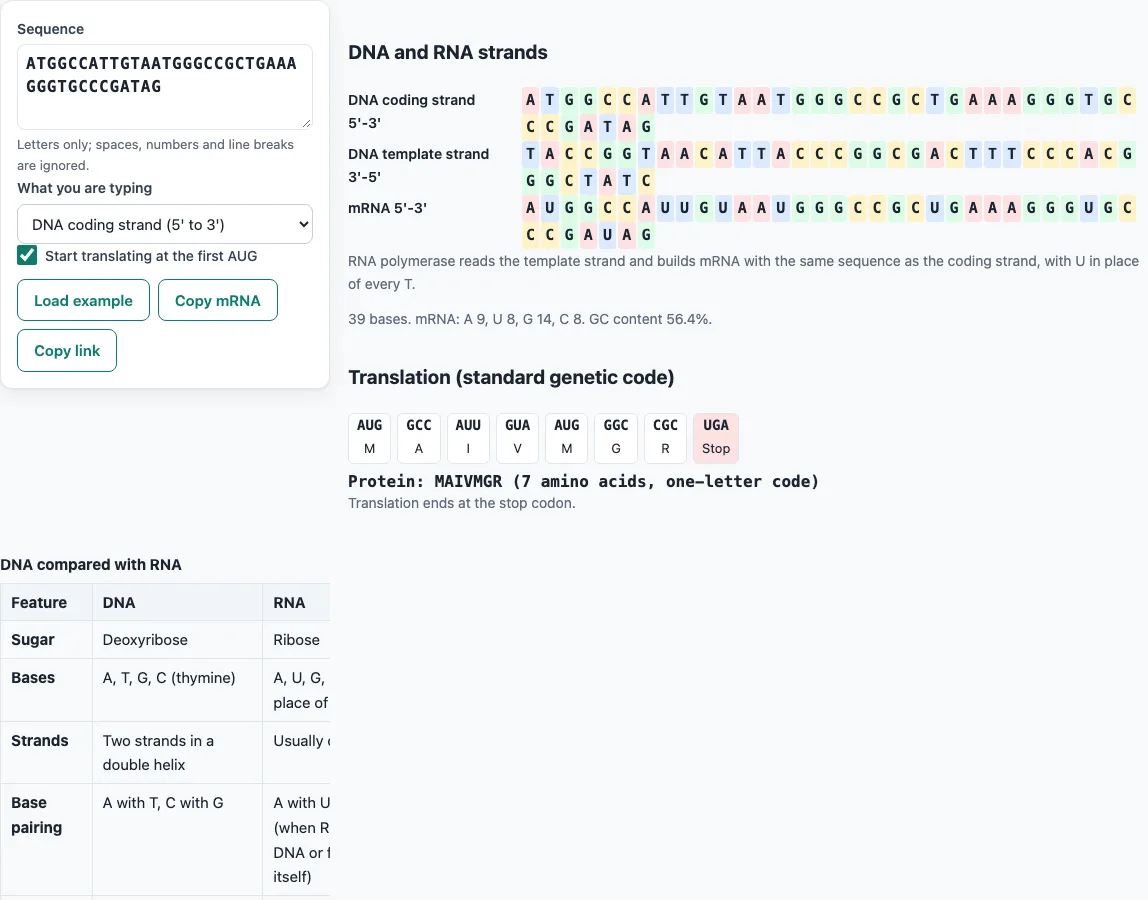
- Read the three strands in the results. They appear in colour-coded letters, with a line showing the number of bases.
- Check the A, U, G and C counts for the mRNA and the GC content.
- Read the translation row. It shows codons with one-letter amino acids, the protein as a string of one-letter codes, and whether translation ended at a stop codon.
- Tick Start translating at the first AUG if you want translation to begin at the first AUG start codon.
Load example fills the box with a worked sequence so you can see the output before using your own. Copy mRNA copies the mRNA result, and Copy link copies a link. If you type a U into the DNA box, the tool shows an error, because a DNA sequence can only contain A, C, G and T. An RNA sequence can only contain A, C, G and U.
What is the difference between DNA and RNA
DNA and RNA are both nucleic acids, built from chains of nucleotides, and both carry genetic information. The main differences are the sugar, the bases, the number of strands and the job each molecule does. DNA stores genetic information over long periods, while RNA mostly carries copies of genes and helps build proteins.
DNA is usually a double helix of two strands. RNA is most often single-stranded. DNA is found mostly in the nucleus of a cell that has one, while RNA is made in the nucleus and works mostly in the cytoplasm. DNA is long-lived, and RNA is usually short-lived. RNA has several types, including mRNA, tRNA, rRNA and regulatory RNAs. Some viruses use RNA as their genetic material.
What is the difference between DNA and RNA sugar and bases
DNA contains deoxyribose, and RNA contains ribose. Both sugars form the backbone with phosphate groups. Deoxyribose lacks one oxygen atom that ribose has, at the 2’ carbon, which is why it is called “deoxy”.
Both molecules use A, G and C. DNA uses T (thymine), while RNA uses U (uracil) in its place. DNA pairs A with T and C with G. RNA pairs A with U and C with G.
How do you convert a DNA sequence to RNA
Keep the coding strand and replace every T with U. The result is the mRNA, which has the same sequence as the coding strand with U in place of T. You can also start from the template strand: take its base-by-base complement. Because the template is written 3’ to 5’, the complement reads 5’ to 3’ and is the coding strand; then replace T with U.
For example, the coding strand ATGGCCATTGTAATGGGCCGCTGAAAGGGTGCCCGATAG gives the template strand TACCGGTAACATTACCCGGCGACTTTCCCACGGGCTATC and the mRNA AUGGCCAUUGUAAUGGGCCGCUGAAAGGGUGCCCGAUAG. Read in codons from the AUG start, this gives AUG GCC AUU GUA AUG GGC CGC UGA, which is Met-Ala-Ile-Val-Met-Gly-Arg-Stop, or the protein MAIVMGR. The tool uses the standard genetic code: 64 codons, with AUG as the start and UAA, UAG and UGA as stop codons.
What is the template strand and the coding strand
The coding strand has the same sequence as the mRNA, apart from T in place of U. The template strand is the complementary strand. The tool shows it written 3’ to 5’, so each base lines up with the base it pairs with. The mRNA is built by reading the template strand, which is why the template is the one that gets copied.
Why does RNA use uracil instead of thymine
RNA uses uracil (U) where DNA uses thymine (T). Both bases pair with A. The difference is a methyl group (a carbon with three hydrogens) on thymine’s ring, which uracil lacks. A common explanation is that cytosine can lose an amino group and turn into uracil. Because DNA normally contains no uracil, the cell can recognise it as damage and repair it.
Frequently asked questions
Is the DNA to RNA converter free to use?
Yes. Everything on this page is free to use, and the converter runs in your browser.
Does it upload my sequence?
No. Nothing you type is uploaded, and all calculation happens in the browser.
Why does the tool say my sequence is invalid?
A DNA sequence can only contain A, C, G and T. If you see an error, check the menu choice and the letters in the box. A U in a DNA sequence will cause an error.
What does “Start translating at the first AUG” do?
When ticked, translation begins at the first AUG codon, which is the start codon, rather than the first base of the mRNA.
What is GC content?
GC content is the share of bases in the sequence that are G or C. The tool shows it with the base counts for the mRNA.
Does the tool do RNA splicing or reverse complement searches?
No. The tool does not do RNA splicing, reverse complement searches, mutation effects or sequences from files. It reads one sequence typed or pasted into the box.
Which option should I choose if I only have the template strand?
Choose DNA template strand (written 3’ to 5’). The tool then works out the coding strand, the mRNA and the translation from it.
Related tools
- Biology worksheets: Pick a topic such as cells, genetics or the human body and print a worksheet with an answer key.
- Punnett square calculator: Predict the genotype and phenotype ratios of a cross.
- Cell labeling worksheet: Use this to practise naming the parts of a cell.
- Animal classification worksheet: Use this to practise sorting animals into groups.
- Chemistry worksheets: Generate equations, tables and half-life problems with a calculated answer key.