Dependent Variable Identifier
Paste an experiment question or fill in two boxes to name the independent, dependent and controlled variables, then print a blank data table.
Recent
Your last 10 settings, saved only in this browser. Nothing is uploaded.
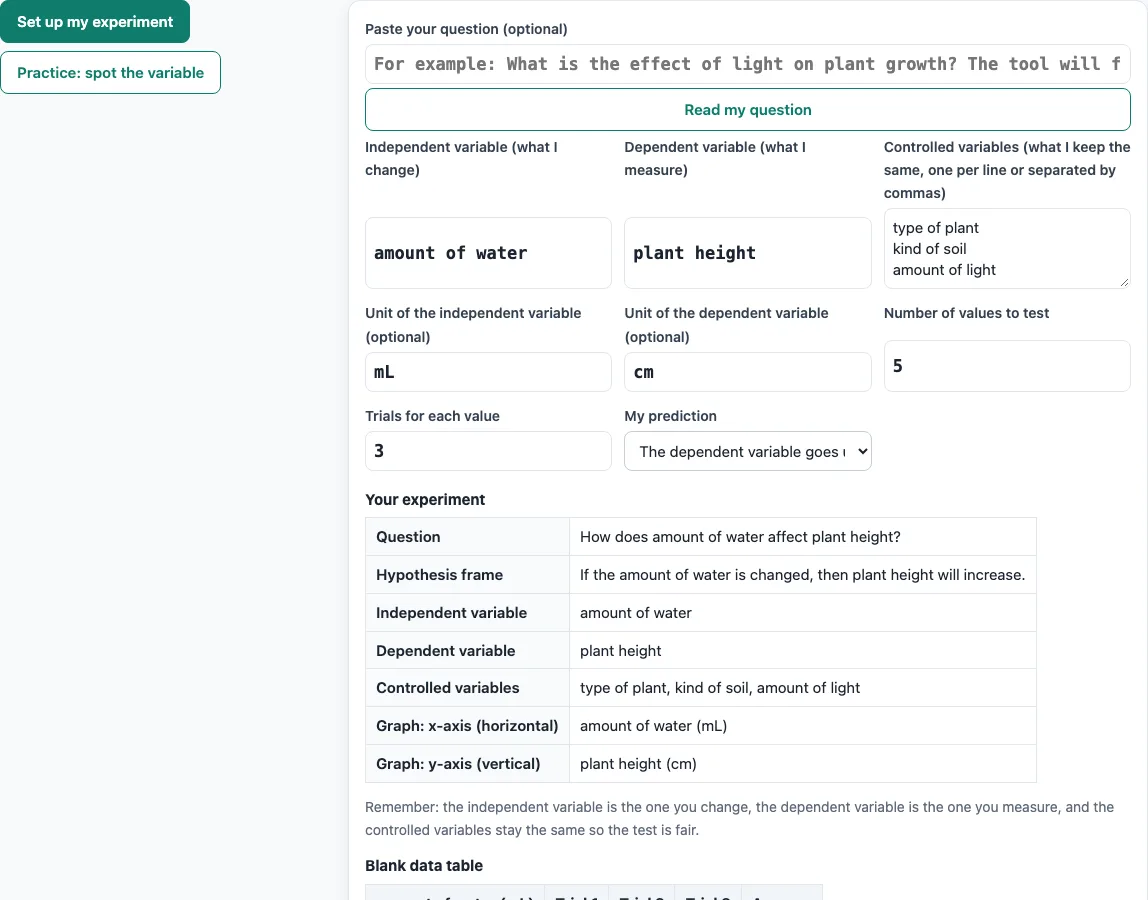
How to use the Dependent Variable Identifier
- Open the Set up my experiment tab.
- Optional: paste your question into Paste your question (optional) and click Read my question. It understands wordings such as “the effect of X on Y”, “Does X affect Y?”, “How does X change Y?” and “How does Y change with X?”
- Check the boxes Independent variable (what I change) and Dependent variable (what I measure). Edit them if the question reader got something wrong.
- In Controlled variables, list what you keep the same, one per line or separated by commas.
- Add units for each variable if you have them.
- Set Number of values to test and Trials for each value. The defaults are 5 rows and 3 trials.
- Pick a prediction from My prediction: the dependent variable goes up, goes down or changes.
- Read the Your experiment table. It shows the question, hypothesis frame, the three variable roles, the x-axis and y-axis, and the blank data table.
- To test yourself, open Practice: spot the variable, choose dependent, independent or controlled under Ask me about, read the experiment, pick one of the three answers, and click Next experiment.
Use Copy table to copy the data table tab-separated, then paste it into a spreadsheet. Use Print to print the page, and Copy link to save your settings in a link you can return to.
What is a dependent variable?
The dependent variable is the factor you measure or record in an experiment. Its value depends on the independent variable, so it is the effect, not the cause. A handy memory aid is that it is the one that “depends” on what you changed. In a test of how water affects plant height, plant height is the dependent variable.
What is an independent variable?
The independent variable is the factor the experimenter deliberately changes. It is the cause being tested. In short, the independent variable is the thing you change on purpose. In a test of how fertilizer amount affects plant height, fertilizer amount is the independent variable.
What is the difference between independent and dependent variables?
The independent variable is what you change, and the dependent variable is what you measure. They work as a pair: the experiment checks whether changing the first produces a change in the second. A fair test changes one independent variable at a time, so any change you see in the dependent variable can be linked to that single change.
How to find the dependent variable
Ask two questions. “What am I measuring or recording?” gives you the dependent variable. “What am I changing on purpose?” gives you the independent variable. Everything else that could affect the result should stay the same. In a question written as “the effect of X on Y” or “Does X affect Y?”, X is the independent variable and Y is the dependent variable.
What is an example of a dependent variable?
In a bean plant experiment where the amount of water per day is changed, the dependent variable is the plant height after two weeks. In a sugar cube test, where cubes are dropped into water at different temperatures, the dependent variable is the time it takes the sugar to dissolve. In a test of how hours of sleep affect a runner, the dependent variable is the runner’s time. Each one is the result you record. These dependent variable examples all share one pattern: the dependent variable is a number you can measure, such as a height, a time or a count.
What are controlled variables?
Controlled variables are the other factors kept the same so the test is fair. They are also called constants or control variables. In the bean plant experiment, the controlled variables include the type of plant, the amount of light, the kind of soil and the room temperature. A factor you did not control that changes the result is called a confounding variable.
Which variable goes on the x-axis?
The independent variable goes on the horizontal x-axis, and the dependent variable goes on the vertical y-axis. In the tool’s default example, the x-axis is “amount of water (mL)” and the y-axis is “plant height (cm)”.
Frequently asked questions
Is the Dependent Variable Identifier free to use?
Yes. The tool is free to use, and everything is calculated in your browser.
Is my experiment uploaded anywhere?
No. Nothing you type is uploaded, because all calculations happen in your browser.
Will the question reader always fill the boxes correctly?
Not always. It handles common English wordings only, so check the two boxes after clicking Read my question and fix any mistakes.
Does the tool check whether my experiment is well designed?
No. It names the independent, dependent and controlled variables, but it does not judge the design beyond that.
What is a confounding variable?
A confounding variable is a factor that is not controlled and changes the result. Keeping controlled variables the same helps prevent this.
Can I check my understanding of variables?
Yes. The Practice tab gives you 14 short experiments, and after each answer it says whether you were correct and lists the independent, dependent and controlled variables.
What is the independent variable definition?
The independent variable is the factor the experimenter deliberately changes to see what happens. In the tool’s default example it is the amount of water. Everything you measure in response is the dependent variable.
Can I print the data table?
Yes. Use Print to print it, or Copy table to paste it into a spreadsheet.
Related tools
- Scientific method worksheet: use it to practise the steps of a science investigation from question to conclusion.
- Lab report template: use it to write up your results once you have chosen your variables and collected data.
- Biology worksheets: use them for more practice with experiments and data in biology lessons.
- Kindergarten science worksheets: use them for simple, early science activities for young learners.