Coriolis Effect Calculator
Enter a latitude, a speed and a travel time to see how strongly the Earth's rotation pushes a moving object sideways.
Recent
Your last 10 settings, saved only in this browser. Nothing is uploaded.
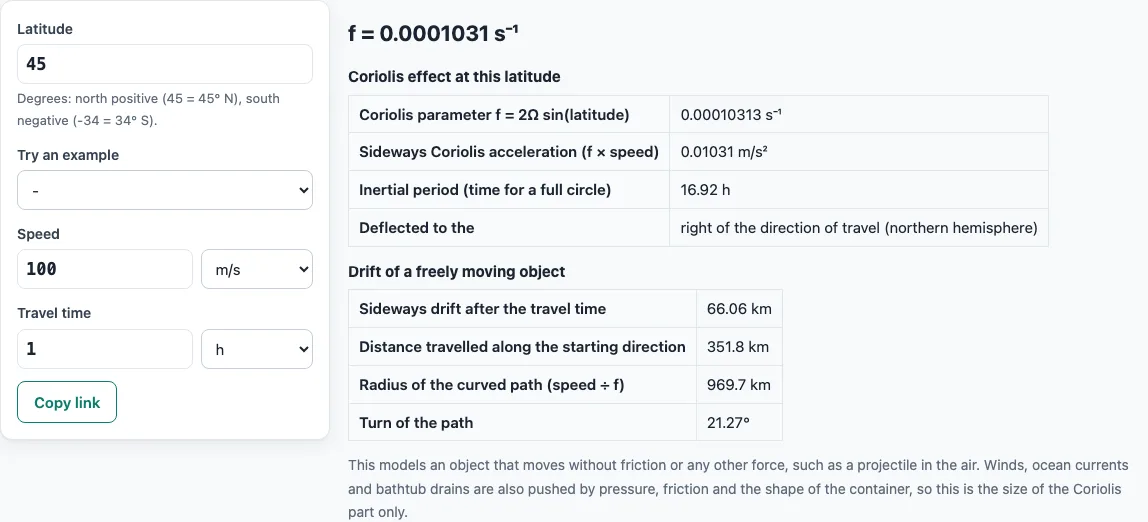
How to use the Coriolis effect calculator
- Type a latitude in degrees into the Latitude box. Use positive numbers for north and negative numbers for south. The value must be between -90 and 90.
- Or open the Try an example menu and choose a place, such as New York (40.7° N) or Sydney (33.9° S), to fill in the latitude for you.
- Type a speed into the Speed box, then pick its unit from the menu: m/s, km/h, mph or kn.
- Type a travel time into the Travel time box, then pick its unit from the menu: s, min or h.
- Read the headline, which gives the Coriolis parameter f for your latitude.
- Check the table Coriolis effect at this latitude for the sideways acceleration, the inertial period and the side the object is deflected to.
- Check the table Drift of a freely moving object for the sideways drift, the distance travelled along the starting direction, the radius of the curved path and the turn of the path in degrees.
The defaults are latitude 45, speed 100 m/s and travel time 1 h, so results appear as soon as the page loads. If you enter text that is not a number, a negative speed or time, or a latitude outside the allowed range, the tool refuses the value and shows an error message. To keep your settings, select Copy link. The link saves them, so you can return to the same calculation later.
What is the Coriolis effect?
The Coriolis effect is the apparent deflection of moving objects when they are viewed from a rotating frame, such as the spinning Earth. It appears because the ground turns beneath a moving object, so the object’s path looks bent from the surface. The sideways push that describes this in calculations is called the Coriolis force, or Coriolis acceleration when it is written as a rate of change of velocity. It matters most for large, long-lasting motions such as winds, ocean currents, hurricanes and long-range artillery.
Which way does the Coriolis effect deflect in the northern hemisphere?
In the northern hemisphere, the Coriolis effect deflects moving objects to the right of their direction of motion. In the southern hemisphere, it deflects them to the left. This is why large storms spin counter-clockwise in the northern hemisphere and clockwise in the southern hemisphere. The tool shows the side for any latitude in the row “Deflected to the,” so you can check the Coriolis effect direction for a place you enter.
How to calculate the Coriolis effect
Start with the Coriolis parameter, f = 2Ω sin(latitude), where Ω = 7.292115e-5 rad/s is Earth’s rotation rate. An object moving horizontally at speed v feels a sideways acceleration a = f × v. With no other force acting, it travels on a circle of radius v ÷ |f|. After a time t, it has moved v ÷ |f| × sin(|f|t) along its starting direction and drifted v ÷ |f| × (1 − cos(|f|t)) to the side. For short times, the drift is close to ½ f v t².
Here is a worked example at 45° N. The Coriolis parameter is f = 1.0313e-4 s⁻¹. For a speed of 100 m/s (360 km/h), the sideways acceleration is 0.01031 m/s². Over 1 hour, the model gives a drift of 66.06 km to the right, a distance of 351.8 km travelled along the starting direction, and a curve of radius 969.7 km that turns the path by 21.3°.
These formulas describe the Coriolis part only. They assume a freely moving object with no friction or pressure force, and they use a flat-plane approximation.
Why is the Coriolis effect zero at the equator?
At the equator, sin(0°) = 0, so the Coriolis parameter is zero and horizontal motion gets no sideways acceleration. The effect depends only on the part of Earth’s rotation that points along the local vertical. At the equator, the rotation axis lies flat against the ground, so that part is zero. The effect grows as you move toward the poles, where the Coriolis parameter is largest. At the North Pole, the tool gives f = 1.4584e-4 s⁻¹.
What is the inertial period?
The inertial period is the time an object takes to complete one full circle under the Coriolis effect alone. It equals 2π ÷ |f|. The tool gives 11.97 h at the pole, 13.82 h at 60°, 16.92 h at 45°, 23.93 h at 30° and 68.9 h at 10°. There is no circle at the equator, because f is zero. The speed changes the size of the circle but not the time it takes to go round.
Does the Coriolis effect make toilets flush in different directions?
No. The Coriolis effect is far too weak to decide the swirl direction in a sink or toilet. The shape of the container and the water’s initial motion dominate. The effect only becomes noticeable for large, long-lasting motions over large distances.
Frequently asked questions
Is the Coriolis effect calculator free to use?
Yes, you can use it at no cost. Everything is calculated in your browser, and nothing you type is uploaded.
What does the Coriolis parameter f mean?
The Coriolis parameter f is a number that depends only on latitude. It is calculated as 2Ω sin(latitude), and its unit is s⁻¹. Multiply it by an object’s speed to get the sideways acceleration.
Why is the Coriolis parameter negative south of the equator?
South of the equator, sin(latitude) is negative, so f is negative. The sign shows the deflection is to the left rather than the right. The size of the effect is the same as at the same distance north of the equator.
Does the calculator model vertical motion or the centrifugal force?
No. The tool handles horizontal motion only, so it does not model vertical motion. It also does not include the centrifugal term.
Why do real winds not follow these circles?
Real winds balance the Coriolis force against pressure forces, so they do not travel in the circles the drift model shows. The model assumes no other force acts on the object. Use it to see the size of the Coriolis part, not the full path of a real air mass.
What do the error messages mean?
The latitude must be between -90 and 90 degrees. Speed and travel time cannot be negative. Any entry that is not a number is refused. Correct the value in the box, and the results will update.
Related tools
- Earth, space and science method sheets: Use these when you need step-by-step method sheets for Earth and space science topics.
- Solar system worksheet: Use this to practise facts about the planets and other bodies in the solar system.
- Water cycle worksheet: Use this when you are studying evaporation, condensation and other stages of the water cycle.
- Physics worksheets: Use these to practise the forces, motion and rotation ideas behind the Coriolis effect.